
Reach your goals the right way. See why you should venture into Facebook’s newly released ad units and targeting types. Don’t let other social media companies give you the merry-go-round. Let us show you how to swing into gear.
First there are some rules you need to know:
Make sure your ads live in the best neighborhood with Premium.
Run your media on the most prime locations. Premium ads can be displayed on the News Feed and Profile Pages, boosting engagement among users.
Bigger is better. The six Premium ad types can have images up to 20% larger than Marketplace ads, ensuring more users interact with your ad.**
Going Retroviral: Once a user interacts with your Premium ad, whether it be RSVPing to an event or responding to a poll, the unit expands encouraging even more user engagement. These ad units can self-replicate, creating the potential for stories to be run in friends’ newsfeeds.
If you want top performance no matter the cost, Premium ads are the way to go. These ad units are expensive but worth the cost if your brand is already well known in the social space or if you are offering something big.
No need to solicit strangers, you can now target only the specific users you want with Custom Audiences. Using your client email and phone number database, we can target only the consumers relevant to a specific promotion or offer.
Your client can be identified through their known email or phone number upon signing on to Facebook. From there we can decide what ad type or copy to direct at them.
Custom Audiences should be used for campaigns that focus on rewarding your current customers and is not the right choice for acquiring new fans. These can be special offers, such as discounts or sales that you know your current customers may have an interest in.
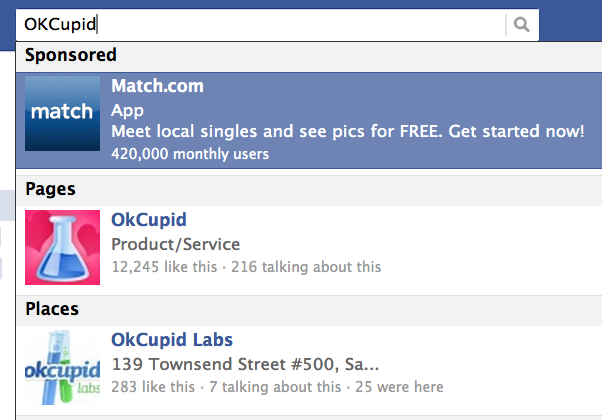
Be exactly where and what people are looking for. With the launch of Facebook’s Sponsored Results, Socialtyze is now offering our own custom approach to targeting your potential consumers based on similar Apps, Pages, and Places they are searching for.
You can be the first one in line by targeting an App or Page related to your brand and you can show up as the top sponsored result.
Sponsored results can benefit brands with a high concentration of competitors in social media. Target users who are searching for your competitors and use them to build your brand.
Campaigns with specific promotions or trending topics also have the potential to perform well with sponsored results.
Not all three services are well- suited for every campaign. These new services can benefit your brand as long as you keep in mind the core goals and purpose of your campaign.
Now that you know all the rules, it’s time to play.
Tag, you’re it!

Last month, a panelist at MediaPost’s Social Media Insider Summit demonstrated the brilliance of Instagram and other social niche-works with a single keen observation. As the panel bandied about the topic of who uses Twitter and why, a young man piped in with this articulation:“I mean, like, really, who cares? Like, I mean, like seriously, like who cares what I’m doing right now? And I certainly, don’t care what you’re doing (pointing to another panelist) right now.”
Precisely. In what was surely a gift from the irony gods, four minutes later the same fellow claimed his favorite social platform was Foursquare – the granddaddy of “this is what I’m doing right now” apps. Amen.
The danger with Twitter is that users have no control of the content coming in. You absolutely can choose whom to follow (and unfollow), but the reality is Twitter feeds have become a free-for-all of brands hyping products, blogs linking to articles, retweets and replies, that one friend who is positive his 140 character observations are comedy gold and on down the line. The inmates run the asylum and for at least one of the folks on this panel, that meant a steady diet of “At the gym. #GTL baby.”
Luckily there is a solution and it comes from observing the Oracle of Restraint himself, Mr. Jobs. Apple has built the realm on its warlock ability to know just how much control users should have (and not have). Applications – yes. Base operating system – no.
For the best example of an application that forces users down a single path to the land of joy and happiness, look no further than Instagram. Just shy of its second birthday, the newly minted jewel in the Facebook portfolio reached its 100,000,000th active user. Keep in mind, for most it’s life Instagram only lived on a single mobile operating system and still doesn’t support web based photo uploads. So that’s 100M mobile only users. Users who have grown to love the mind-numbingly simple app that boils the experience down to a very simple act: upload a photo. Instagram users know precisely what they’re in for when they open the app and they only have two ways to get in on the action: upload or engage. You can like or comment, or you can upload. It’s that simple.
This same linear experience is driving other networks to success as well. Pinterest, like Instagram, is built on users’ insatiable appetite for images. The experience is more complex with the ability to curate and add others’ content to your collection, but the content itself is always the same. Certainly there is a danger that eventually all to see will have been seen, but that is where brands must realize a tremendous opportunity as content creators and conversation shapers.
The users have spoken and the path has been laid. App builders – build it simple, build it linear. Content creators – adapt to the tools that give users the power to create simply and publish quickly, and people will care what you’re doing.

At Socialtyze, data is at the core of everything we do. We’ve developed and honed complex processes for data analysis over several years. The umbrella term we like to use for this is “Social Listening”, and while it implies a passive ‘listening to’ data, it in fact is a much more involved process. Let me start with an analogy of a teacher on her first day with a new class. Her job is to assess the levels and personalities of the students. What’s her trick? She listens. The actions, words and behaviors of the children comprise the ‘data’ that comes into her full view. She then takes this information and begins to define children by types and capabilities. She then devises a strategy based on her analysis and understanding and applies it to the various groups. All the while she stays focused on her core objectives, and she optimizes and improves her strategy over the course of the year. In essence, that is exactly the same process we take with our clients when we listen to their social data. Let me explain.
Social Listening, as I mentioned earlier, is a term used to describe a larger social data methodology that we use here at Socialtyze. The process begins with one of two start points: Data mining or data harvesting. The distinction between the two is that data mining is when we find a data source and ‘turn it on’ so to speak, and the data comes flowing in and we look for patterns and relationships within the data set. Data harvesting, by contrast is typically a web crawling methodology that is often referred to as ‘focused web crawling’; it is the application of human or machine built query parameters in the data mining process, i.e.: “Go look for data of this sort.” Both processes are a form of data gathering. At Socialtyze we focus our attention equally between data mining and data harvesting processes. We scour a client’s social data in a pre-defined query based methodology and we also mine large amounts of available social data via various social APIs.
Once we have the data the next step is to determine what to do with it. This is where it gets interesting. This is where our process of Social Listening takes an important and industry distinctive direction.
Looking at the chart above you can see that we’ve broken data analysis into two phases. This chart should be looked at as a depiction specifically of social data analysis. To date, we’ve seen a tremendous amount of data gathering, which is evident in the proliferation of social media dashboards that showcase brand or individual user data points like: followers, engagements, trending data, leaderboards etc. And it would be unfair and inaccurate to portray the present and near past as an environment devoid of social data mining and harvesting. There are many great companies out there providing these services in very important and interesting ways today. Where Socialtyze differentiates itself is in the application of this data in the specific objective of delivering real and measurable earned media ROI to brands in social media.
What we do is mine and harvest social data, we ‘listen’ to the engagement and performance history of the data, and then we use what we’ve learned to set parameters within predefined guidelines (algorithms in some instances) that output an optimal earned media ROI focused strategy for social media actions by our clients. This is a stark contrast and departure from the days of harvesting and mining data and merely presenting it to a client as a discussion point. Our methodology and system delivers a true and actionable data strategy. The results: our clients see massive increases in engagement and reach within social in the range of 100’s of percentage points time and again. This entire process of gathering, listening, analyzing, deriving strategy and creating an actionable data driven plan is what we call “Social Listening.”
I’ll end with a personal story: Prior to taking on the role of Managing Director at Socialtyze, I ran the broader social media effort at Demand Media. This was a company that taught me the importance of social listening and that learning formed the basis for much of what we do here at Socialtyze in the realm of data analysis. Demand Media ‘listened’ to the SERPs (search engine results pages) and determined what type of long tail content people were consistently searching for. They then built a studio of writers and wrote that content for those people. They also devised a powerful strategy for delivering those articles to the end user and for reaching higher levels of ranking within the SERPs so that users could reach this content quickly and easily. The point is: They proved tremendous value to the end client by listening to data, organizing a strategy out of what they learned and delivering an actionable data plan in order to reach their target audience. Similarly here at Socialtyze, we listen to our client’s social data, we devise a strategy based on what we learn and we deliver an actionable plan and the tools and services to execute on the plan in a holistic and an ever more intelligent way. That, in a nutshell, is what we call “Social Listening”.
Socialtyze - All Rights Reserved 2022