

How Smart Marketers are CapitalizingFrom Pope Francis to Darth Vader, from Obama to Kim Kardashian, everyone seems to be taking selfies. Ellen DeGeneres tallied 33 million views and 2.4 million retweets for her Oscar Selfie. Oxford Dictionaries even announced “Selfie” as the Word of Year in 2013.Whether you like it or not, “The Selfie” is here to stay.I find selfies fascinating. Not so much for myself, although I do take them now and then, but for marketers. The Selfie provides an excellent opportunity for marketers to support an activity that people are already doing and integrate themselves into existing conversations in authentic ways.With selfies, brands can encourage fans to become part of an insta-community built around an activity or theme that is on brand and serves a specific strategic purpose.Here are four examples of great Selfie campaigns:

Hostess capitalized on the fact that Twinkies look just like Minions and partnered with Universal to create TwinkieMinions.com to provide fans with the opportunity to win a trip to Paris.

Fashion Designer Marc Jacobs put out a casting call to find the “Next Face of Marc Jacobs”. To become eligible, fans posted to Instagram or Twitter using the hashtag #CastMeMarc . Within one day they received 15,000 entries and by the campaign’s end, reported a total tally of 70,000.

Beats did a campaign called Solo Selfie to promote Solo2. With the support of some major celebrity talent, Beats has asked consumers to take a video selfie from one side of the headphones to the other and post using #SoloSelfie. Over 9,000 users participated.

California Pizza Kitchen (CPK) designed What We Do For Love during Valentine’s Day and tapped influencers, including top talent from The Bachelor, to post what they do for love along with #CPKLoveSweeps. Participants vied for the opportunity to receive CPK for a year, and all images were pulled into a feed gallery app, creating an insta-community centered on CPK and Valentine’s Day. CPK followed the campaign with a Dear Mom sweepstakes that allowed fans to post selfies celebrating their moms for a chance to win a trip to Las Vegas.Next week in Part Two of this post, we will address how you can measure the impact of Selfie campaigns, as well as best practices and things to consider when planning your campaign.Want more tips and tricks for how to dominate social this year with Data, Creative and Amplification? Download our 2016 Social Media Survival Guide.

Having worked in the studio industry for what felt like a lifetime, and overseeing 70+ digital marketing campaigns for theatrical releases, I’ve learned the importance of a well-balanced movie campaign. For example, a successful media campaign needs the right creative to create buzz, and a high reaching TV campaign isn’t as impactful without a targeted social post endorsing the film. Yet, as we immerse more deeply into the automated world of programmatic advertising, I am alarmed when I read how marketers are shifting more and more of their dollars into this space. As much as programmatic media allows us to efficiently pinpoint our target audience through data sources leveraging behaviors, affinities and look-alikes, relying solely on this sways the marketing scale too heavily into the mechanical void of non-personalized media.A successful digital movie campaign requires a more balanced mix of high reach and contextually relevant media. It doesn’t stop at programmatic, it levels out the automation with the synchronized execution of an Influencer campaign creating an emotional connection with its audience through well-tailored authentic messages. Influencers not only lend trustworthiness, they contextually align their allegiance with the passions and behaviors of their readers and followers. An authentic message has over 6 times the efficacy of a generic post.[1]With the proper lead time, instituting the following guidelines will help you execute a successful Influencer program in film marketing, ensuring you’re connecting with your audience, and ultimately driving box office dollars.
Side Note: Stop thinking Influencer Marketing is only for the millennials. 62% of Facebook, 60% of Pinterest and 59% of Twitter’s audiences are 35+[2]. Done right, a successful Influencer campaign can engage the masses as well as target niche audiences alike – all with powerful endorsements you can’t buy through media alone.
Want more tips and tricks for how to dominate social this year with Data, Creative and Amplification? Download our 2016 Social Media Survival Guide.

Ethnic targeting is notoriously difficult for any marketer. We’ve heard it all: linguistic profiling, targeting by hyper-specific area, targeting by interest, or JUST language. All of these felt, to be kind, shoddy in their construction.In years past, Facebook has worked hard to develop a more robust and accurate profile. They use their partnership with Datalogix to pinpoint credit profiles overlain with census data to build a real ethnic targeting capability.You read that right; they’re using credit card info to target your ads. Creepy as it sounds, it blows away any competitive targeting parameters in the ethnic arena. The result is a full offering that is especially useful in Hispanic Marketing.The real development here is the opportunity to target bilinguals, which at 60% of the US Hispanic population is the Holy Grail.

But the truth is any one of those groups is too broad for the type of hyper-targeted buy our clients are used to. They don’t want to target Asians. They want to target millennial Asians who are coastal and love action movies. That’s why Facebook’s ability to layer targeting puts it head and shoulders above the publisher network approach.Targeting by race alone is as silly and, candidly, lazy as you can get. Seth Godin made his name by encouraging marketers to “Find their tribe”. In essence, find a cohesive group of people with shared ideas and values that have similar purchasing patterns. The same could be said here. We do a lot of movie marketing at Socialtyze, horror movies especially. The Hispanic audience drives that opening weekend and as a result we work hard to match our creative, targeting and approach to extremely tailored profiles. That can include testing bilingual copy, overlaying interests against larger purchase profiles, and A/B testing creative.In sum, Facebook’s ethnic targeting is the premiere approach to a problem that has plagued marketers for a long time.Want more tips and tricks for how to dominate social this year with Data, Creative and Amplification? Download our 2016 Social Media Survival Guide.

Here at Socialtyze, we interface with tons of social media platforms, including Facebook, Instagram, Twitter, and Vine, just to name a few. So you can imagine an API that’s designed with the consumer in mind means a lot to us. It allows us to focus more on the creation of our own apps, rather than fussing with irritating queries, rate limits and user tokens. With that in mind, I’d like to single out a few features on a couple of APIs that make a developer’s life easier (or harder).
1. Instagram rate limits included in the headers
If you’re like us, you make hundreds or thousands of calls to Instagram’s API every hour. This makes rate limits a real factor in the way we design our back end apps. This makes knowing - and keeping track of - how many remaining calls you have a critical piece of information. The last thing you want to happen is to have your account throttled by the Instagram servers and completely shut down your app.
Thankfully, Instagram actually returns that information with each call you make to the API:
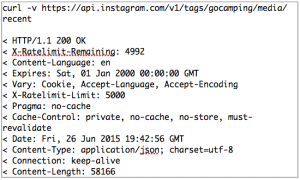
Since you get both the total number of calls remaining and the total you started with, you can regulate your queries based on how many calls you have.
Instagram isn’t without its faults though. Good luck trying to get the comment and like data for media through their API. Each endpoint is capped at around 150 entries - and no pagination! So if you want to see the entire list of users who liked your photo - you’re out of luck!
2. Twitter’s real-time streaming endpoint
Twitter’s RESTful Search API is great, but as we all know - it’s built for relevancy and not completeness. Since not every tweet is indexed to search, you only get results within a certain time period and even then, relevancy is key. This is where the Twitter Streaming API comes in. We’re able to listen to hundreds of different hashtags in real-time, funneling them into a global tweet database for our clients to access. This is great because we get to examine the data on our own terms without having to deal with pesky rate limits. One downfall of the Twitter Streaming API is that it only provides you up to 1% of the total volume of tweets on the service. This means that if you’re listening to a hashtag that has significant activity - you’re going to lose some tweets. This is where the RESTful Search API comes in again. We’ll use this service to perform a daily backfill of tweets we may have missed. Using these two APIs in parallel allows us to be confident that we’ve caught every tweet we can.
3. Google Analytics API
For many internal analytics dashboards, we turn to Google Analytics to provide the data on our apps. It’s convenient for developers, and it’s reassuring to clients because they’re already familiar with the metrics that Google Analytics provides. That being said, Google makes it a bit of a chore to authenticate your server application with their API. On top of the normal Client ID, you’ll need to pull down a json file along with a P12 cryptographic key to make calls to the Google service API. This type of authentication may seem excessive, but this method is used to authenticate with every single API on Google’s servers. This means you can access BigQuery, the Prediction, or Google Drive APIs all through the same app, if they’re enabled.
4. Facebook’s Pagination
Facebook’s API has gone through numerous iterations over its lifetime. Facebook’s pagination design is great when it works - and extremely frustrating when it doesn’t. Facebook chose to go with a couple different methods of pagination depending on which API endpoint you’re calling. It could be cursor based, time based or offset based. This can be hard to work with at first because often times Facebook will not tell you which pagination scheme works with each endpoint.
As an aside, one of the great things about Facebook is that you can file a bug directly with Facebook through their website. Is the endpoint you’re working with giving you trouble? Open a ticket and let them know!
5. Vine’s Tag API
Vine’s API is a great, simple API. There are a few endpoints that you can access, and you don’t have to mess around with any app tokens (yet). The pagination is ‘page’ based, meaning that you are given a set amount of vines per page, and can move through the pages by page number (eg. 1,2,3,4, etc). You typically see this type of pagination when building an app that allows the user to paginate through results instead of the server. For instance, if an app were displaying a list of top vine videos, there would be a ‘next’ button for the user to click.
That’s great for user facing apps, but for developing server side applications, we’ve run into a couple of issues. For starters, there is no way to return results based on where you left off from a previous query. You can’t query based on date, and you can’t retrieve newer results from the last time you queried. This may have a lot to do with Vine seemingly being hesitant to bring the API from out of the shadows and into the public eye. As it currently stands, Vine’s API isn’t officially documented. Hopefully we’ll see more consumer focused API design in the future as Vine decides to make their API more public.
Want more tips and tricks for how to dominate social this year with Data, Creative and Amplification? Download our 2016 Social Media Survival Guide.

We always recommend running promotions several times throughout the year for our clients. They’re not only the perfect way to reward your loyal fans, but they’re also integral in growing your fan base, building buzz, and supporting brand initiatives such as in-store events or new product launches.
In order to make sure your promotion is solid from top to bottom, you need to plan everything out in advance. Our team loves to map out our promotions on a good old whiteboard, with the below tips in mind.
First things first, you need to figure out your objective. Follower growth? Brand awareness? New product launch? Promotions are great for all of these goals. If your demographic is majority female, a Mother’s Day or Valentines Day promo is a slam-dunk. If you’re a restaurant launching a new menu, this is the perfect way to drive restaurant consumers to participate. You can even align your promotional event with a Foodie Holiday - these are huge trending topics!
Don’t forget to strategically map everything out. Should your campaign live on Facebook, Instagram or Twitter? It’s not rocket science - if you’re a photo-centric brand, then Instagram is always a safe bet.
The majority of promotions include a hashtag. This is where you can really be creative – don’t be afraid to think a little outside of the box on this one. It doesn’t always need to include your company name, but make sure you do a little research before you ink it. If your hashtag has already has been used hundreds of times, it’s probably not the unique hashtag you should be using for your campaign.
I can’t stress enough the importance of working with your legal team to create explicit rules, as well as triple checking that you are in compliance with each site’s terms of service. To make it even easier, you can work with our developers here at Socialtyze to build a Facebook app to house your promotion, the process is super simple and we’ll get things up and running with no headache to you.

Beautiful pieces of creative and must-watch videos are essential to make your campaign stand out in today’s crowded marketplace. For example, if your campaign runs for two weeks, we’d recommend launching with a video, and some straightforward how-to creative outlining all the important parts of your promotion. Halfway through the campaign, it’s time to highlight some of the best entries you’ve received (as long as you have the rights and it’s a random drawing). Finally, don’t forget to catch any late stragglers with a “Last Chance to Enter” post!
[embed]https://www.youtube.com/watch?v=h6OA7e6JcW0[/embed]
Unless you have millions of followers, you don’t want to just rely on your social channels to drive awareness and participation. Put up in-store collateral in a place that will be seen by the most eyeballs. Reach out to partners and sponsors for cross promotions. Tap into your email database and send an eBlast with a compelling subject line. And invest some money into a media buy to create awareness around the promotion. Facebook and Twitter have endless options, and, as of early June, Instagram has opened up its advertising platform to anyone who can foot the bill.
Important: don’t spam your fans with promo message after promo message. Space it out across your different platforms and only post about it two times a week max. Let’s not anger the base!
One of my biggest pet peeves is seeing poor promotional communication. You really need to be clear in your instructions, your copy and all communications regarding the campaign. For example, do they need to follow you in order to qualify? Are they reposting your photo or posting their own? What’s the hashtag and how many times can they enter? This should all be outlined in your rules, but it’s safe to assume 95% of consumers don’t usually read those. It goes without saying that your community manager should be monitoring their social channels on a daily basis, but promotional posts are especially important. Make sure to answer all questions, engage with fans, and be enthusiastic about their participation. If you notice someone posted a photo to enter, but they don’t follow you, let them know! Did someone post a great photo? Share it with your fans! The more involved you are in the campaign, the more successful it will be.

Congratulations, you just completed your promotion - what’s next? It’s essential to create a recap deck to figure out what went right, what could be improved on, and recommendations going forward. Was the campaign too long? Did users seem to enjoy it or was participation lower than past promotions? Evaluating the data is just as important as any of the other listed steps. Make sure everyone that touched the promotion on your team has some input into this recap process, including the creative team, community managers, media, etc. This will help you when planning your next promotion and push your team to create something even better the next time around.
Want more tips and tricks for how to dominate social this year with Data, Creative and Amplification? Download our 2016 Social Media Survival Guide.
Socialtyze - All Rights Reserved 2022