

“Help! How do we stand out on Instagram?” It’s a question that brands ask us all the time. Up until last month when Instagram ads began rolling out, it was an even playing field for ALL users. Seeing that follower number rise and acquiring comments and likes isn’t as cut and dry as it is on other platforms. Brands really have to have a clear strategic vision in order to both succeed and stand out on IG.
So, how do the brands that are crushing Instagram do it?
They Tell A Story
What does your brand represent? I understand if you’re a clothing company and you think the right thing to do is post a photo of a different product everyday - just take a step back. On Instagram, it’s more about conveying both the lifestyle of your brand and fan, and thinking about what they want to consume on a daily basis.
Let’s take a look at Nike, who takes the crown for #1 brand on Instagram with 23.1 Million Fans. That number is absurd. And their feed is SO much more than shoes and athletic wear. You see images of people running, striking landscapes, friends swimming in the ocean, a woman doing crunches on a bench. The product is the afterthought… it’s always there but it’s never thrown in your face. Of course this won’t work for everyone, but mixing up your content is incredibly important and powerful.

They Provide Value
If anyone watched this year’s Emmys, you know how hilarious Amy Poehler was when they panned to her face during The Best Actress in a Comedy category. Cosmopolitan Magazine did a slam dunk when they created and posted this meme just minutes later! I texted it to friends and saw it reposted hundreds of times the following day. Now, that’s one clever community manager who got stuck working on a Sunday!

Their Emoji Game Is Strong
No matter what industry your brand is in, make sure you’re integrating emojis in your strategy. Emojis are a universal language; you’ll never confuse the heart symbol with anything else. It also seems much more organic and familiar, which is something that brands should strive for in their social media messaging. According to a recent study by Instagram, a month after the launch of the emoji keyboard in 2011, 10% of the captions and comments on Instagram contained at least one emoji. In 2015, that number has exploded to almost 40%, with emoji’s replacing words, Internet slang, and some captions completely. I see you Hilary Clinton!

They’re Smart About Video
In order to compete in today’s market, you’ve got to invest time and resources into video content. Do you have a new product launching? A video is much more powerful than a static image to convey your awesome new offering. Additionally, understanding your target demographic is especially important for video. Millennials with short attention spans need something particularly engaging and entertaining in order to keep them from scrolling down their feed. Also remember that many consumers look at Instagram with no sound – always consider this when creating your videos OR explicitly make a note about the sound in the copy.
A video posted by McDonald's (@mcdonalds) on Aug 28, 2015 at 1:36pm PDT
They’re Generous!Running monthly or quarterly promotions is another way to build your following and excitement for fans. It’s also a great way to get new eyeballs on your page. Benefit Cosmetics is absolutely killing it on Instagram with 2.3 Million followers. Not only do they provide value with makeup tutorials and encourage people to post selfies with their hashtag, they run monthly giveaways for some seriously sweet makeup prizes. Their contest photo and hashtag last month was shared over 7,000 times on Instagram. That number is HUGE for a contest that requires a fan to regram a photo, and it only ran for two days. Multiply that by 12 for each month of the year and you’re looking at potentially almost a million reposts.

Their Photos Are BeautifulLast but not least, make sure your photos are beautiful and interesting. Make sure photos are well lit, crop them in interesting ways, and show off your beautiful product. This is especially important for our many clients in the restaurant space. If you wouldn’t put the photo up on a billboard or in your menu, don’t post it. Similar to taking the right selfie, you need to get the perfect food-porn shot. As a consumer trying to figure out a new restaurant to try, the first place I look is their Instagram page. In order to stand out, you’ve got to capture the food in the best possible light – don't these sliders make you just want to lick your screen?
Ditch those #MondayBlues. This will help you slide through the day.A photo posted by Who Song & Larry's (@wslcantina) on May 11, 2015 at 11:14am PDT
Want more tips and tricks for how to dominate social this year with Data, Creative and Amplification? Download our 2016 Social Media Survival Guide.

Since its inception in 2010, Instagram has grown to 400 million monthly active users, making it one of today’s most powerful mobile advertising platforms. Until recently, Instagram ads were only made available as direct buys with Facebook to a select group of Facebook Marketing Partners and agencies. This pilot run consisted of 400 campaigns globally and resulted in a 2.8x higher brand recall than Nielsen’s norm for online advertising. Here are the five things you need to keep in mind when advertising on Instagram.
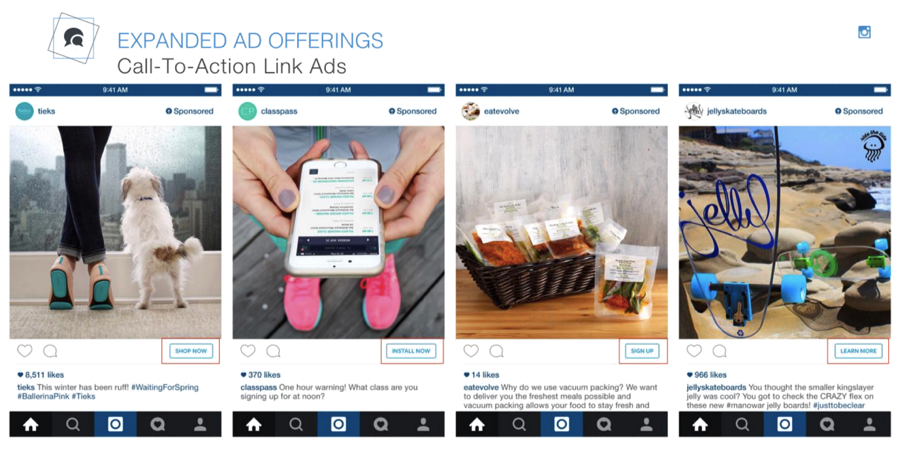
It’s vital for every ad buyer to be versed in the different ad formats in order to match the ad type to the campaign objective. The ad offering has been expanded from Photo Ads, Video Ads and Carousel Ads to include Call-To-Action Link Ads. Brands want to drive a variety of business objectives such as generating brand awareness, increasing reach, driving website visits or stimulating offline sales. The new direct response format bridges the gap between brands objectives and user demands.
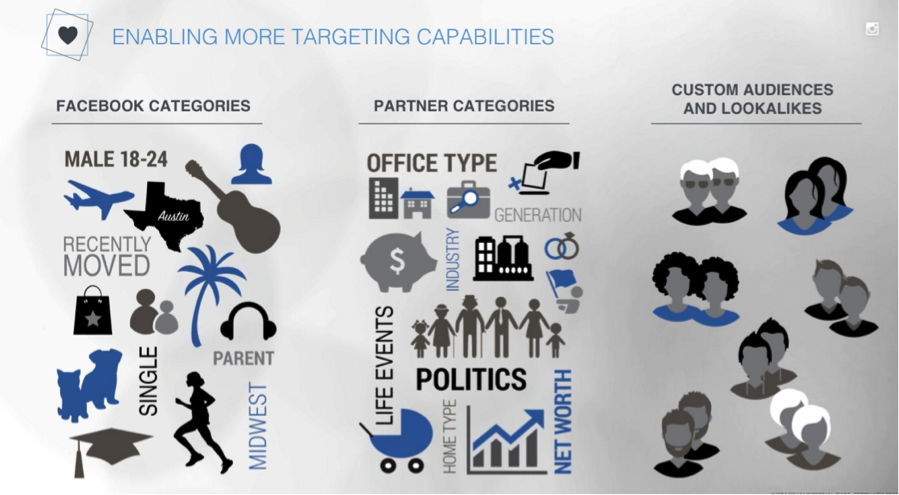
Everything you’ve learned from Facebook can be applied to Instagram. So if you’ve seen success from a certain targeting group on Facebook, there is a good chance that will carry over. The wealth of Instagram’s new product offering lies in the substantial targeting capabilities that will transfer over from Facebook user profiles. Interest and demographic targeting as well as options for direct response initiatives create numerous strategic opportunities.Ad targeting can be tailored so that users will see ads for the things they care about. The ability to leverage Facebook categories, Partner Categories, Custom Audiences and Lookalikes will help advertisers reach people based on their interests and not just their age, location and gender, making ads more relevant and efficient.
Think about your brand promise and how consumers perceive your brand. Consider beyond the tangibility of your business offering and create a visual display of your brand to highlight feelings that are evoked through the use of your products and services.It is fundamental that brands identify what they want to communicate to their Instagram community and then maintain a clear and consistent representation of the brand across all creative, both paid and organic. Users should be able to quickly perceive your brand message when they visit your account. Include your logo and any brand elements that are recognized by your consumers and stay consistent with color.
Create an idea that resonates with your audience through images that are memorable. Visuals can produce powerful messages to drive metrics, so focus on building a theme or concept to tell a story about your brand. Don’t just take pictures! Add meaning to your content by connecting your brand to experiences and environments that make sense.

Details are important. On Instagram, you are publishing content to users with high-resolution screens so take extra time to develop a solid point of focus for your creative. Be clear and concise in your composition. Design a polished image by giving extra attention to lighting, framing, balance and symmetry.Overhead shots (as pictured below) have long been a top performer for food and fashion photography. Leverage those organic insights for your ads and employ a photographer who knows what works in social.


Happy Instagramming!Want more tips and tricks for how to dominate social this year with Data, Creative and Amplification? Download our 2016 Social Media Survival Guide.

If a company posts on Facebook without paid media, does anyone ever see it? More and more, we are finding that less and less people do. While this fact remains true, our analysts have discovered an upside to increasing organic reach. Unfortunately, you still need to buy Facebook media but it appears that Facebook is following Larry Page’s mantra of “Always deliver more than expected”. Facebook is not only delivering on the guaranteed paid impressions on a post but it is also increasing the non-paid (a.k.a. organic) impressions of a post as a way of saying thank you.Our analysts pulled some hard numbers on four examples (below).Client 1:· Average Organic Reach on normal posts: 22,056· Average Organic Reach on promoted posts: 34,589· % Increase: 57% Client 2:· Average Organic Reach on normal posts: 1,811· Average Organic Reach on promoted posts: 3,262· % Increase: 80%Client 3:· Average Organic Reach on normal posts: 2,476· Average Organic Reach on promoted posts: 5,897· % Increase: 138%Client 4:· Average Organic Reach on normal posts: 10,168· Average Organic Reach on promoted posts: 72,149· % Increase: 710%

The range is pretty varied – from 57% to 710%. This may be because there are several factors that we are not controlling such as, content type, vertical, time of day, etc. In order to draw definitive conclusions, more analysis needs to be done. But, the trending is pretty clear – in the four instances tested the WORST-case scenario was a 57% increase in organic reach. As worst case scenarios go, that’s not too shabby.So what is the main takeaway?While brands need to buy media to be relevant on Facebook, we seem to have discovered a silver lining. With paid media, Facebook will amplify both your “sponsored” and organic reach, making your posts even more valuable and allowing your message to be more visible. In addition, brands that are relying solely on organic reach for their posts are becoming less and less relevant on Facebook, as the social network is favoring its paid customers even more.While this is tough news for some, we see another upside. The pairing of organic and paid lift in the algorithm provides an opportunity for partnership between your media buyers and community managers. Facebook appears to be supporting the premise that paid and earned teams should work in tandem to maximize results for a brand. By working together, they can determine which messages should be promoted to gain an extra bump in organic reach or said another way, to gain more engagements, shares and conversions for a better ROI.Want more tips and tricks for how to dominate social this year with Data, Creative and Amplification? Download our 2016 Social Media Survival Guide.

Reporting analytics is an under-appreciated subject in marketing and advertising. We all know that campaigns live and die by the trends of their KPIs, but where do those KPIs come from? Are they hand curated by artisan data analysts, laboriously crunching numbers with a slide rule and a magnifying glass? In most cases, no - they’re actually taken from many big names like Google, Adobe, Yahoo!, Kissmetrics, Mixpanel, and others. These services generally use javascript snippets to trigger events and track sessions on your page, sending the data back to their own servers.

That doesn’t mean that retrieving metrics is easy. You have to be pretty familiar with each service to find the data you want - and if you want to do anything more complicated, like cohort analysis or funneling, you’re going to want to get very familiar with the documentation. It becomes even more difficult if you want to incorporate your own internal data sources into the mix. Are you storing data in a relational database and want that put into Google Analytics? Your developers better know how to integrate your system to the Google Analytics API.In the past, Socialtyze has generally communicated analytics data through email, or what is most often the case, through a google analytics custom dashboard. The problem with email, is that it just doesn’t scale very well. It’s obviously very human intensive, and eventually reporting consumes the majority of the analyst's time - instead of actually doing the analysis! We also played around with using custom dashboards through Google Analytics. This works great for very basic numbers, but it gets very difficult to customize to what you really want to show to the client.

Here at Socialtyze, we decided that it was time to simplify the process. We create a huge number of apps, and we think that clients should be able to have access to those KPIs for each app, any time they want. That’s why we created Qu, a data analytics dashboard that ingests demographic and engagement data from Google Analytics and our own internal sources, and provides it to you in an easy to use display.Qu will allow our clients the ability to actively monitor the performance metrics of their apps, and look back to reference the performance of previous apps that they have ran. It serves as the main dashboard for the client, allowing Socialtyze the ability to focus on creating high quality apps and providing the client with key metrics they can take to the bank.Want more tips and tricks for how to dominate social this year with Data, Creative and Amplification? Download our 2016 Social Media Survival Guide.

A tectonic shift in how brands connect with customers and drive sales is currently taking place. By 2017, the internet will overtake television to become the dominant advertising medium, earning 36 percent of total ad spend compared to TV's 35 percent, as reported by Digiday. With an average return on investment of $6.85 for every $1 invested in digital influencer marketing work, it's easy to see why brands are diving headlong into this space. It's where the smart money is going, so it's imperative that you familiarize yourself with this vast world before actually taking the plunge.To date, four specialties have emerged among influencer companies: talent agency, technology/SaaS, content network, and influencer agency. Here's a helpful guide to understanding the differences between them.
Modeled after traditional talent agencies, this group of companies focuses on the creator. They have a broad roster of creators they can tap when an advertiser knocks on their door.Pros: Talent agencies are a one-stop shop for a brand to access top influencers. This is very much the traditional Hollywood model. Casting a film? Call Creative Artists Agency (CAA). Need an influencer for your brand? Also call CAA -- if you can afford it.Cons: The talent agency's allegiance is to the talent. It's their job to sell their collection of influencers for the highest price possible. They also usually lack the technological capabilities to successfully track and report on campaigns. When 75 percent of influencer marketers report struggling to "find the right influencer," and 25 percent report having a hard time automating their campaign management, these cons become worrisome.
Software as a Service (SaaS) companies provide the technology for you to manage influencer relationships and steward individual campaigns. For the data geeks among us, these tech platforms (like Socialix, TapInfluence, and Traackr) also provide a wealth of analytical tools that allow you to find and manage influencers and drill down into campaign performance and measure ROI. When most companies are using Google to find influencers and spreadsheets to manage campaigns, SaaS companies automate the process and create efficiencies that save time and money.Pros: To increase efficiency, brands need powerful technology. It's simply the only way to reliably manage influencer campaigns and grow your business.Cons: They are first and foremost tech companies. Campaign strategy and management simply aren't their strong suit. They rarely understand the intricacies of identifying the right set of influencers based on campaign goals, or coming up with big creative ideas to mobilize those influencers.
If "content is king," then these guys are the royal court. These networks support their legion of influencers with substantial creative resources to produce the most compelling content. By combining the work of like-minded influencers, they build a network of editorial they can monetize. They are churning out great, high-quality content at a breakneck pace.Pros: You'll pay a premium, but when contracting with a content network you can rest assured you'll be getting high quality content for your brand given the resources these companies are investing in development.Cons: Content networks have an inherent bias. They're best served when brands buy into specific channels of content that they've spent significant time developing. Like talent agencies, they are most loyal to their core roster of influencers and will sell those options much more aggressively than other influencers who may be more relevant for the brand. Most importantly, there's the issue of fee transparency. Many of these networks make it almost prohibitively expensive. These networks intermingle media revenue with influencer revenue. So you're charged for the influencer and you pay premiums to run ads. In the end, network markups are very hard to ascertain.
The influencer agency exists to serve the brand's interests. They're the umbrella organization that corrals all of the moving parts and aligns them with the brand's goals. They let the talent agencies worry about the creators, they own or license the technology tools, and they tap into the content network when the audience and opportunity make sense. They're able to focus on the brand and offer end-to-end campaign management. They'll define campaign goals and develop unique multi-phased campaigns integrating core messages. Good agencies will curate a database of influencers across multiple talent agencies and networks, and they'll manage the campaign from ideation to execution.Pros: Because they're unburdened by obligations to talent or tech, this segment of influencer companies has the freedom to focus on the marketer, and to build custom campaigns that fit the individual needs of the client. They can provide transparent fees and performance guarantees. As a brand, it's critical to have somebody in your corner whose economic interests are aligned with yours (whether that's through a retainer relationship or a transparent agency fee). They're also marketing specialists who understand the value that these influencers bring to a brand, and will work to establish long-term relationships as well as develop an overarching influencer strategy that evolves with the brand.Cons: Not all influencer agencies are created equal. Some aren't even agencies at all, but rather PR firms who dabble in influencers and have conflicting interests at play. When selecting an agency, insist on one with robust technology, transparent fee structure, and creative minds managing your account.Of course, this overview of specialties is just the tip of the proverbial iceberg. There's a lot of differentiation -- and conversely, overlap -- from company to company. The right decision for your brand requires careful consideration. If there is one takeaway here, let it be this: When selecting an influencer company, keep a watchful eye out for possible competing interests. Influencer marketing is a great investment -- when you do it wisely.
Socialtyze - All Rights Reserved 2022